Every quarter, Mexico's Ministry of Economy publishes its foreign direct investment figures. This quarter, the number made history:
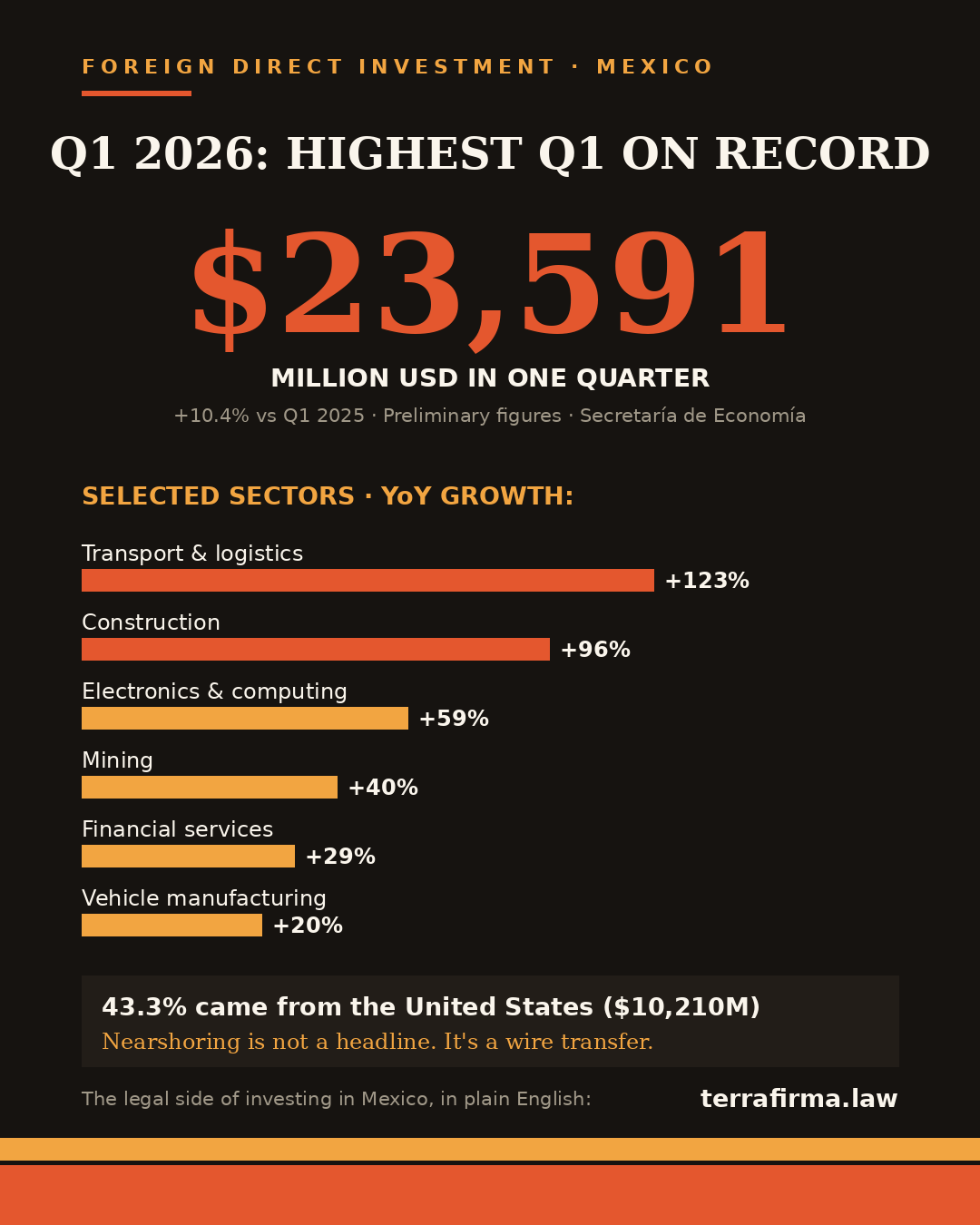
Behind the headline: reinvested profits grew 33.5% to $22,222 million, meaning companies already operating in Mexico are doubling down, while electronics and computing investment jumped 58.7%, mining 39.7%, financial services 28.8%, and vehicle manufacturing 20.4%.
The number is real. The story most people tell about it isn't.
Read the composition before you read the celebration. Of that record $23,591 million, only about 7.2% (roughly $1,705 million) was new investment. The overwhelming majority was reinvested earnings and intercompany accounts: money from companies already in Mexico.
That is not bad news, and it is not a reason to stay away. Capital that knows Mexico is choosing to put more in, which is the most sincere vote of confidence there is. But it does mean something specific: new foreign capital is arriving in far smaller volumes than the headline suggests. Anyone using this record number to tell you "everyone is coming, hurry" is using a true number to say a false thing. We would rather you hear it from us.
The infographic (save it, share it)
 ↓ Download the infographic
What this means if you're the one investing
Records like this one are made of thousands of individual decisions. A plant here, an acquisition there, a services company scaling up. If one of those decisions is yours, three legal notes the press release skips:
1. The money is racing toward land, and much of Mexico's industrial land has an agrarian past. Construction up 96%, logistics up 123%: that's warehouses, parks and plants being sited right now. A meaningful share of Mexico's industrial corridors sits on land of ejido origin, where the question isn't the price per square meter: it's whether the privatization of that land was ever completed correctly. Verifying that chain is a specialty of ours, and skipping it has undone deals far larger than yours.
2. "100% foreign-owned" is real, with a shortlist of exceptions. Most industries allow full foreign ownership through a properly structured Mexican entity. A few strategic activities remain reserved or capped under the Foreign Investment Law, and every foreign investment carries registry obligations (RNIE). The structure is straightforward when it's done at the start, and expensive when it's retrofitted.
3. Reinvested profits are the quiet headline, and the honest one. Companies that came for the pilot stayed for the expansion; that is where nearly all of this record comes from. It is also the pattern we see at street level: the hard part isn't arriving: it's building the legal skeleton (entity, land, labor, compliance) strong enough to be worth reinvesting in. The firms in that 92.8% built theirs, and that is the lesson of the quarter.
Sources: Secretaría de Economía Q1 2026 FDI report (preliminary/original figures, subject to revision), as covered by El Financiero, IMCO and Expansión.
Our free guides cover the same ground at your own pace: The Ejido Trap, the Legal Checklist for Buying Property in Mexico, and more.
Get the guidesWe track these numbers because our clients arrive inside them. If your project is part of the next record, the land underneath it deserves the same diligence as the deal above it. Our corporate practice.
This article is legal information, not legal advice, and does not create an attorney-client relationship. FDI figures are preliminary and subject to official revision. © 2026 Terra Firma Attorneys at Law · terrafirma.law